Virtual Table Dynamics: How Free Poker Interfaces Refine Decision Trees Without Monetary Pressure
Written by Viktor Koch · Aug 14, 2026
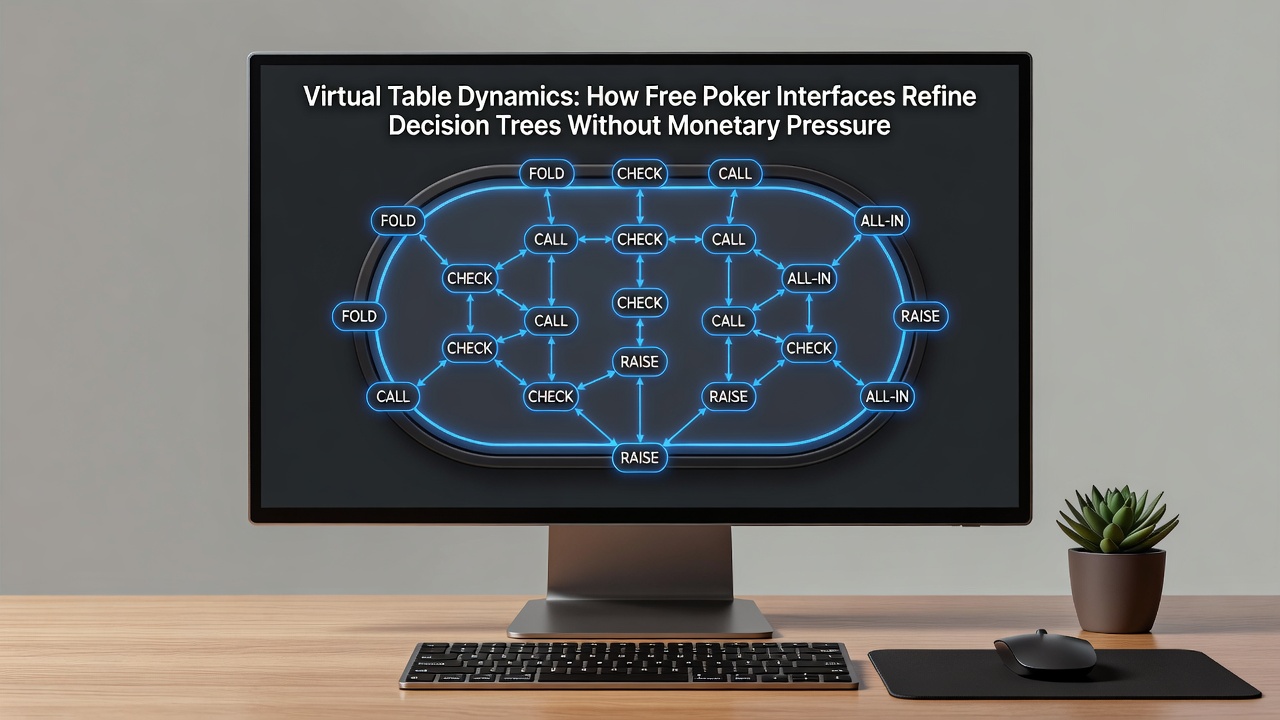
Virtual Table Dynamics: How Free Poker Interfaces Refine Decision Trees Without Monetary Pressure
Free poker interfaces have become central tools for players seeking to map out decision trees in card games where each choice branches into multiple outcomes based on probabilities and opponent behaviors, and these platforms operate without any financial stakes attached. Researchers tracking user patterns in August 2026 note that such environments allow repeated testing of betting sequences, fold thresholds, and bluff frequencies while removing the variable of monetary loss that often compresses experimental range during live sessions.
Data collected across multiple simulation networks shows participants logging extended hours refining positional awareness and pot odds calculations, since the absence of real currency permits full exploration of edge cases that would otherwise carry prohibitive costs. Observers note that decision trees in poker grow exponentially with added variables like stack depth and table dynamics, yet free interfaces compress this complexity into accessible visual overlays and replay functions that highlight optimal branches after each hand concludes.
Core Mechanics of Risk-Free Decision Mapping
Platforms deliver standardized rule sets drawn from established tournament structures, which lets users isolate specific nodes within a decision tree such as continuation betting frequencies on dry versus wet boards. Software logs every action taken across thousands of hands, then generates post-session reports that quantify deviation from game-theory-optimal lines without any penalty for deviation. Those who've studied engagement metrics across browser-based systems find that session lengths extend notably when monetary pressure disappears, allowing deeper iteration on river decisions that rarely surface during short-stakes real-money play.
Algorithmic feedback loops embedded in these interfaces flag inconsistencies in range construction, and users receive immediate visual breakdowns of how alternative choices would have altered expected value along each branch. This process mirrors laboratory conditions where variables remain controlled, enabling systematic refinement that carries over when players later transition to environments with actual stakes involved.
Platform Features Supporting Tree Refinement
Most interfaces incorporate customizable filters that isolate specific scenarios, such as three-bet pots out of position or multi-way limped pots, so users can drill down into narrow decision branches repeatedly. Hand history exports integrate with external analysis tools, creating seamless pipelines from practice sessions to deeper study modules. Figures from industry reports indicate that retention on these zero-stakes environments correlates strongly with feature sets offering real-time equity calculations and range visualization, since these elements accelerate pattern recognition without requiring external coaching.

Cross-device synchronization ensures that progress on mobile drills transfers directly to desktop review sessions, maintaining continuity across study routines. August 2026 platform updates introduced enhanced opponent modeling that simulates adaptive tendencies drawn from aggregated anonymized data pools, giving users exposure to evolving counter-strategies within the same risk-free framework.
Transfer Effects Observed in Player Cohorts
Studies conducted by academic gaming research groups reveal measurable improvements in decision consistency among users who accumulate high volumes of hands on free interfaces before entering paid games. One analysis from the American Gaming Association tracked cohort performance and found reduced frequency of suboptimal river calls after extended simulation practice. Another dataset compiled by the International Association of Gaming Regulators highlighted similar patterns in regional markets where access to free tools precedes real-money participation.
These outcomes stem from the ability to iterate through low-probability branches that surface infrequently in actual play, building familiarity with edge distributions that otherwise remain theoretical. Observers tracking longitudinal data note that the skill refinement occurs most reliably when users actively review post-hand analytics rather than treating sessions as passive entertainment.
Conclusion
Free poker interfaces continue to serve as structured environments where decision trees expand and contract through deliberate practice, supported by logging tools and visualization features that isolate variables without financial consequences. As platform capabilities advance through 2026, the linkage between simulation volume and subsequent performance in real settings remains a focal point for researchers examining skill acquisition pathways in strategic card games.